CalDAV Calendar
CalDAV is an open standard for accessing and managing calendar data over HTTP. It extends WebDAV and uses the iCalendar format for events, tasks, recurring appointments, and attendee data.
Use the CalDAV backend when the target calendar system provides a compatible CalDAV endpoint.
Reference data model: AliasSubCaldav
Alias Configuration
The following example shows a CalDAV backend configuration, such as a connection to a Google Calendar through CalDAV.
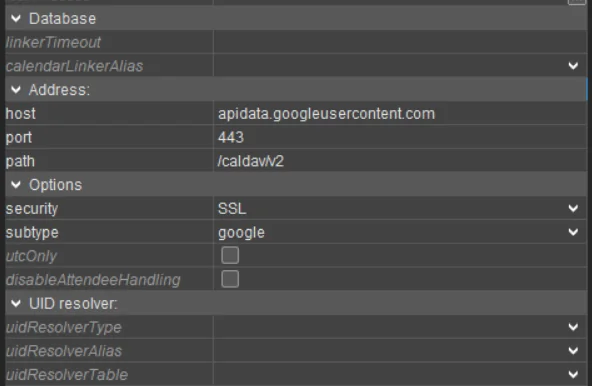 Figure: CalDAV alias configuration.
| Property | Description |
|---|---|
host | Sets the host where the CalDAV service is available. |
port | Sets the CalDAV service port. |
security | Defines whether the connection uses SSL. |
path | Sets the CalDAV path below the host and port. |
subtype | Selects the CalDAV implementation subtype. Available values include NONE, BEDEWORK, APPLE, and GOOGLE. |
disableAttendeeHandling | Controls whether ADITO writes participants directly to calendar entries or sends invitations instead. |
utcOnly | Converts CalDAV appointments to UTC. Enable this only when required by another client, because recurring appointments can be affected across daylight-saving-time changes. |
calendarLinkerAlias | Sets the database alias for the calendar linker. |
linkerTimeout | Sets the query timeout for linker database access. |
uidResolverType | Sets the UID resolver type. |
uidResolverAlias | Sets the database alias for the UID resolver table. |
uidResolverTable | Sets the UID resolver table, typically ASYS_UIDRESOLVER. |
User Configuration
Configure the user's calendarId with the email address or calendar identifier
expected by the CalDAV backend.
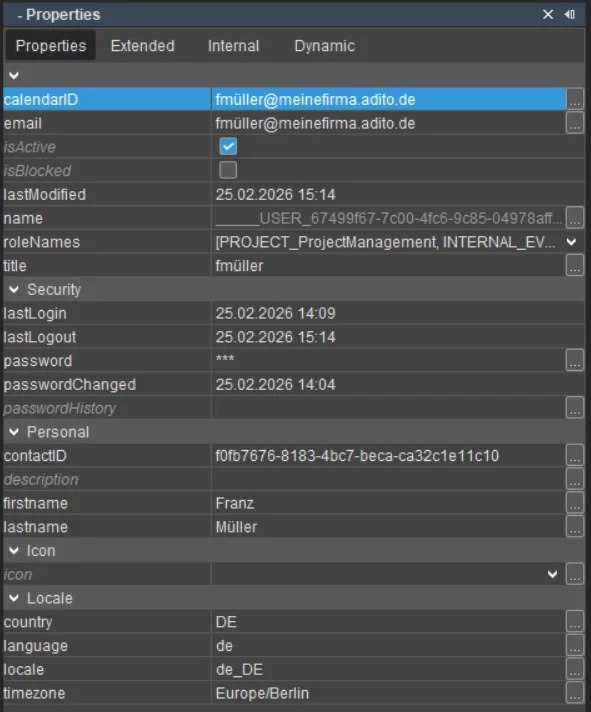 Figure: Calendar ID user property for CalDAV account mapping.
When a CalDAV backend is active, configure the required credentials and calendar path in the user's extended calendar properties.
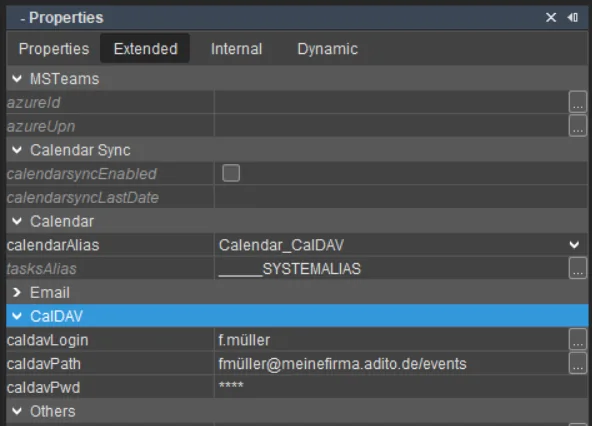 Figure: Extended user properties for a CalDAV calendar backend.
For CalDAV servers with implementation-specific behavior, set subtype to the
matching server family before testing recurring appointments and attendee
handling.